Cascade OKRs
Break down company goals into hierarchical objectives for departments, teams, and individuals to ensure alignment from executive strategy to team execution.
Who Cascades OKRs
Cascading creates hierarchical alignment across the organization:
- Executives set company-level objectives that cascade down through the organization, providing strategic direction for all teams.
- Department Leaders break company objectives into department goals that align with strategic priorities while reflecting departmental focus.
- Team Leads create team objectives as children of department objectives, ensuring team work directly supports higher-level goals.
- Individual Contributors may define personal objectives that support team goals, creating complete alignment from company to individual level.
Permission Requirement
To cascade OKRs: Users need Agility Pro or Premium license. You can add parent objectives to your own objectives only.
To create cascadable parent objectives: Parent objectives must be set to Publicly Readable or Publicly Editable. Private objectives cannot be used as parents.
To remove cascading relationships: Only the creator of the child objective or administrators can remove parent-child relationships.
How Cascading Works
- Leadership sets clear, measurable objectives for the company
- Departments break company-wide objectives into team goals
- Teams divide objectives into individual goals
Cascading Rules
- Users can add parents to public objectives
- Users can only add parents to objectives (not key results)
- A single parent can have multiple child objectives
- A child can have only one parent
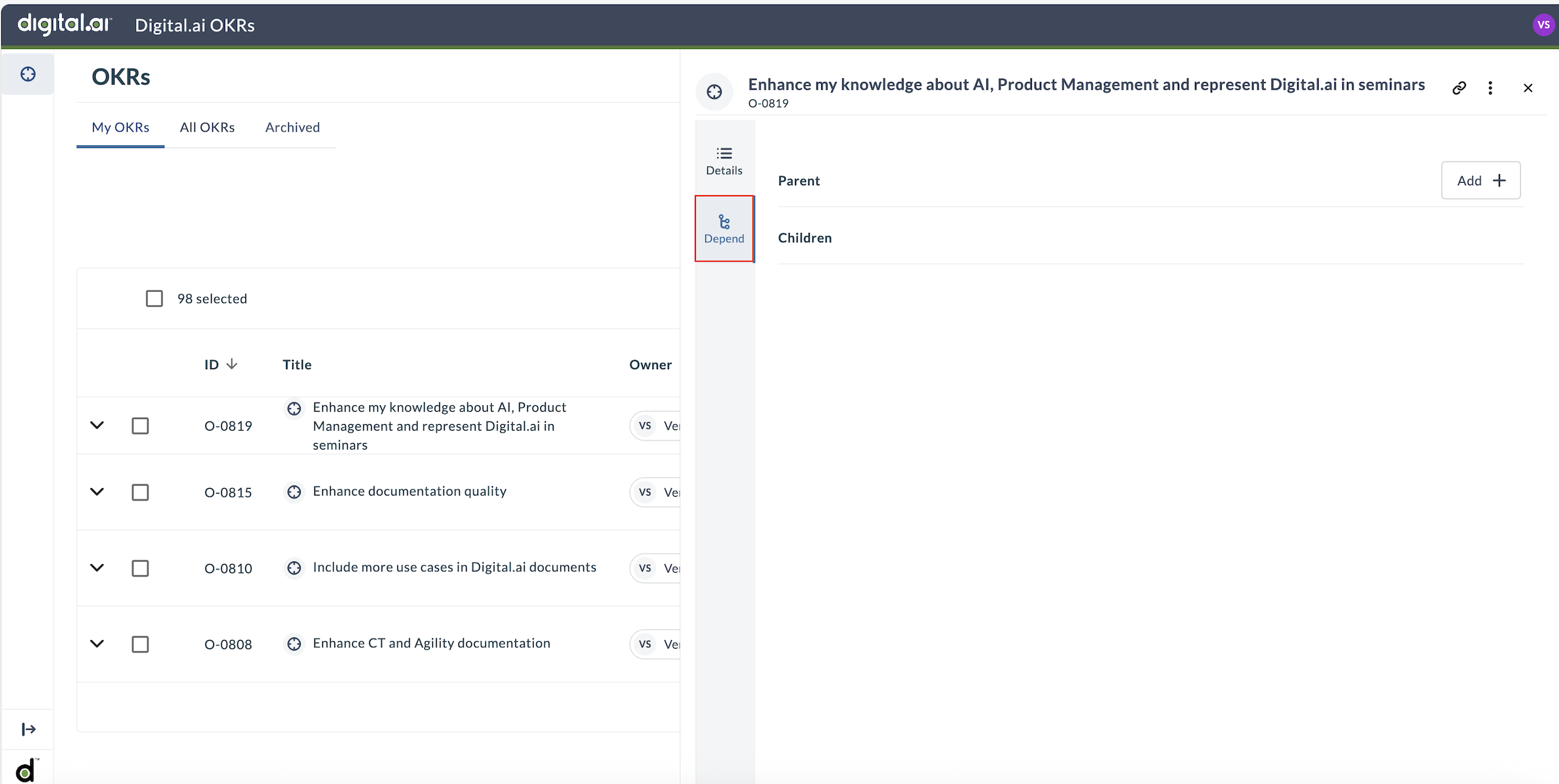
Associate a Parent with an Objective
- Log in to Agility, click the hamburger menu > OKRs.
- Click the My OKRs tab.
- Select the objective to which you want to add a parent.
- Click the Dependency tab.
- In the Parent section, click + Add.
- From the Objectives drop-down, select either Objectives or Key Results.
- In the search bar:
- Enter the Objective ID or Summary if you selected Objective
- Enter the Key Result ID or Summary if you selected Key Results
- Select the Objective or Key Result and click +.
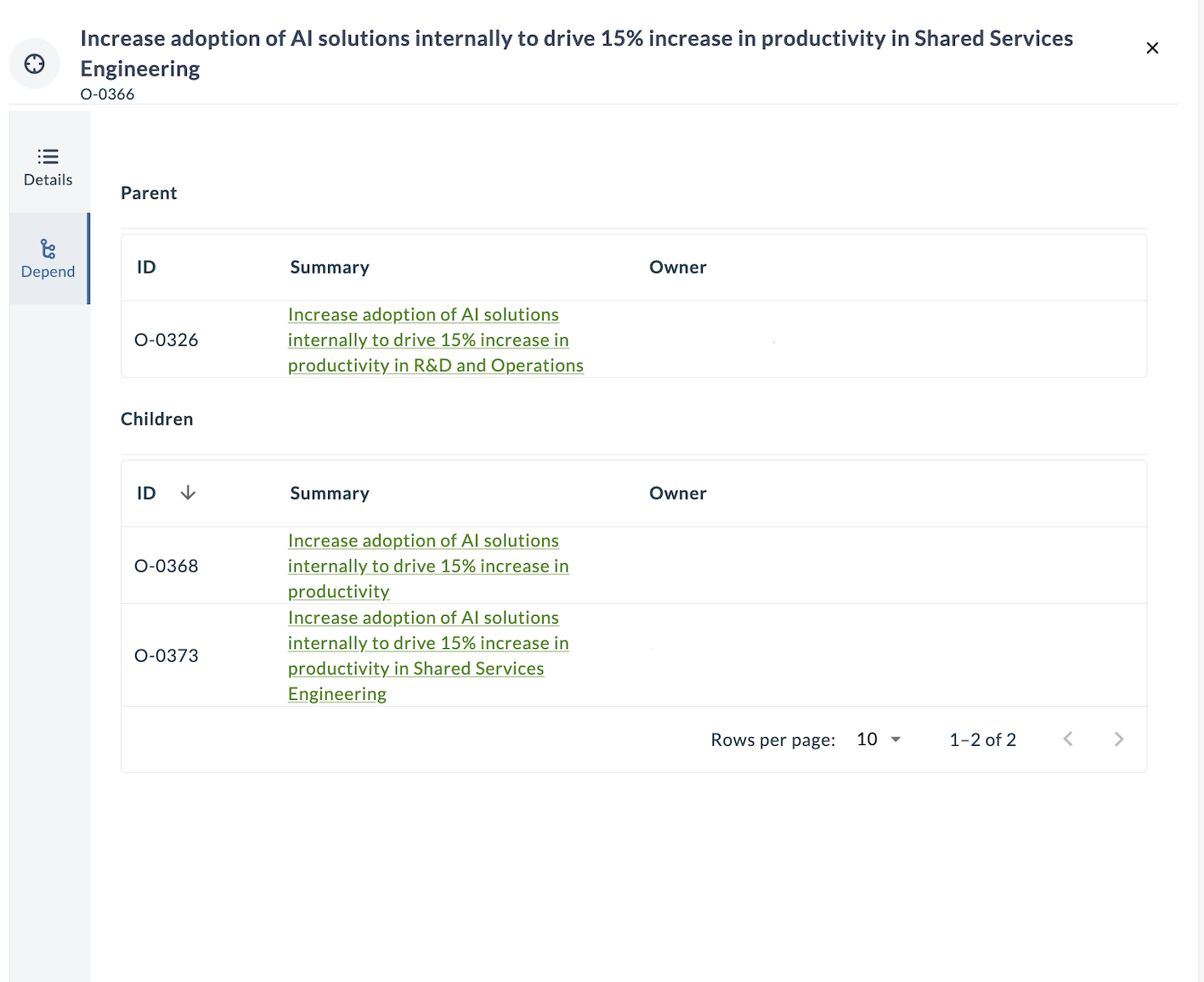
A success message indicates the parent is added. The associated parent Objective or Key Result details display:
Use Cases
Company-to-Team Revenue Cascade
A CEO sets a company objective to increase annual recurring revenue from $10M to $15M. Sales Department cascades this into "Drive New Customer Acquisition" targeting 50 enterprise deals. Product Team further cascades to "Deliver Enterprise Features" focusing on SSO integration. An individual engineer cascades to "Implement Secure Authentication" with specific SAML integration and security audit key results. This creates clear line of sight from individual engineer's authentication work directly to company revenue objective.
Cross-Functional Product Launch Cascade
Company launches new AI Analytics product requiring coordinated OKRs across Engineering, Product, Sales, and Marketing. Executive objective "Successfully Launch AI Analytics Product" cascades to four departments: Engineering builds production-ready platform, Product validates features with customers, Sales builds pipeline targeting $500K ARR, and Marketing drives awareness and lead generation. All four departments work toward shared executive objective with clear contribution paths and dependencies.
Matrix Organization Cascade
In a matrix organization, an engineer reports to functional Engineering manager but works on cross-functional Mobile Banking product team. Engineer's primary OKR "Build Secure Mobile Transactions" cascades from Product Team's "Launch Mobile Banking App" objective, while also maintaining context from Engineering Department's "Improve Engineering Excellence" objective. Engineer has clear primary cascade (product delivery) with context from department (technical excellence), handling matrix reporting while maintaining focus.
Frequently Asked Questions
How many levels should I cascade OKRs?
Small organizations (less than50 people): 2 levels (Company → Team/Individual). Medium organizations (50-500 people): 3 levels (Company → Department → Team). Large organizations (500+ people): 4 levels maximum (Company → Business Unit → Department → Team). Fewer levels provide clearer line of sight to strategy. Each level should represent meaningful scope change, not just org chart hierarchy. Most team members contribute to team OKRs rather than having separate individual OKRs.
Can a child objective contribute to multiple parent objectives?
No, each child objective can have only one parent objective to simplify hierarchy and avoid conflicting priorities. Workarounds: Use Objective Linking to connect related objectives across teams (peer relationships without hierarchy), choose the primary parent and reference others in notes, or create an intermediate shared objective that both contribute to.
What's the difference between cascading and linking objectives?
Cascading is hierarchical parent-child relationship (top-down, child supports parent outcome, represents "how" relationship). Linking is peer relationship (horizontal, bidirectional, many-to-many, represents coordination and dependencies). Use cascading for clear hierarchical alignment and top-down goal setting. Use linking for cross-functional collaboration between peers and matrix organization coordination. You can use both together: cascade for hierarchy and link for cross-team coordination.
Should every team member have their own OKRs?
Most team members should contribute to team OKRs without personal OKRs, promoting collaboration and simplifying management. Individual OKRs are appropriate for leadership roles, sales roles with quotas, specialized roles with unique deliverables, and professional development. Hybrid approach: team members contribute to team OKRs (80% focus) plus 1-2 personal development OKRs (20% focus). Default to team OKRs and add individual OKRs only when there's clear value and measurable individual outcomes.
How do I ensure child OKRs ladder up to parent objectives?
Test the "how" relationship by asking if achieving the child materially helps achieve the parent. Check that child represents 20-50% contribution to parent success. Validate that child's key results directly impact parent's key results with specific mappings. Apply the "eliminate test" by asking if removing the child would prevent achieving the parent. Monitor cascade health by tracking whether child success drives parent progress. Well-aligned cascades have clear line of sight from child work to parent outcomes.
What happens to child OKRs when a parent is archived?
Child OKRs retain their cascade relationship to archived parents and remain active. At end of quarter, archive both parent and children together for clean historical records. For ongoing work, create new parent and child objectives for next quarter. If parent is discontinued mid-quarter, evaluate whether to archive children, re-cascade to different parent, or leave temporarily without parent. Archived cascades preserve strategic context for historical reporting.
Why can't I add a parent to my objective?
Cascading only works with objectives, not key results. Parent objectives must be Publicly Readable or Publicly Editable (private objectives don't appear in the parent list). Contact the objective owner to change visibility settings. Each objective can have only one parent to maintain clear hierarchy.
Related Topics
- Link Objectives - Connect related objectives across teams
- Map View - Visualize hierarchical OKR relationships
- Create OKRs - Create new objectives and key results