Portfolio
The Portfolio menu provides planning, prioritization, and tracking capabilities to manage strategic initiatives across your organization. Focus on higher level planning separate from your product backlog, establish strategic direction, and track progress on large features and epics.
To access Portfolio features:
- Click the hamburger menu.
- Click Portfolio.
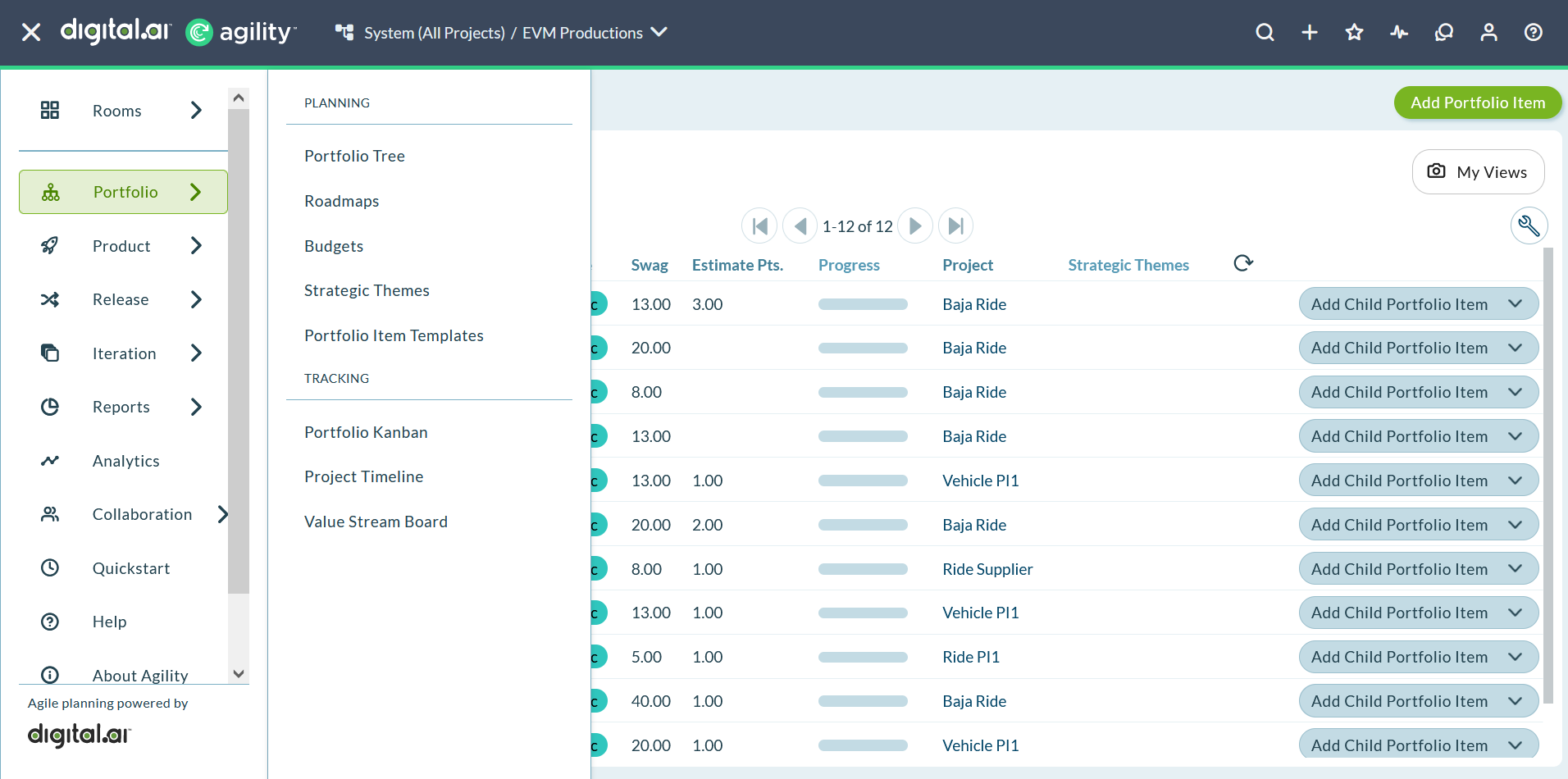
Portfolio Planning
Establish strategic direction, budgets, and roadmaps for coordinated delivery across the organization. Use Portfolio Planning to manage budgets and strategic themes, visualize feature hierarchies with the Portfolio Tree, create roadmaps for stakeholder communication, and forecast team delivery based on capacity.
For details, see Portfolio Planning.
Portfolio Tracking
Track progress on strategic initiatives as teams execute iterative delivery. Monitor workflow with the Portfolio Kanban Board, view dependencies on the Project Timeline, and coordinate large-scale solution delivery with the Solution Board.
For details, see Portfolio Tracking.
PlanningRooms
Collaborate with distributed teams during strategic planning sessions using dedicated planning workspaces. Create custom planning environments for different organizational levels and facilitate remote planning events with real-time collaboration tools.
For details, see PlanningRooms.
Portfolio planning workflows
Strategic to tactical alignment
Connect strategic initiatives to team execution:
- Define strategic themes: Establish business priorities and investment areas
- Create portfolio items: Break down strategic themes into large features or capabilities
- Build roadmaps: Communicate delivery timelines to stakeholders
- Allocate budgets: Set financial constraints and track spending
- Forecast delivery: Predict completion dates based on team capacity
- Track progress: Monitor delivery using Kanban boards, timelines, and reports
- Adjust plans: Refine strategy based on actual delivery rates and changing priorities
Program increment planning
Plan large-scale delivery events across multiple teams:
- Prepare portfolio backlog: Prioritize and size portfolio items before planning
- Set up PlanningRoom: Configure planning workspace with relevant views and reports
- Conduct planning event: Collaborate with teams to commit to increment scope
- Assign teams: Allocate portfolio items to specific delivery teams
- Identify dependencies: Flag cross-team dependencies and coordination needs
- Track execution: Monitor progress on Portfolio Kanban board during increment
- Review outcomes: Assess delivery against commitments and adjust future plans
Portfolio governance
Maintain oversight and control of strategic investments:
- Review portfolio health: Assess progress, risks, and blockers regularly
- Monitor budgets: Track spending against allocated budgets and themes
- Evaluate priorities: Adjust portfolio item rankings based on business value
- Manage capacity: Balance workload across teams and identify constraints
- Communicate status: Share roadmaps and reports with executives and stakeholders
- Optimize flow: Adjust WIP limits and workflow policies to improve delivery
- Measure outcomes: Track business value delivered against strategic objectives
Portfolio planning best practices
Start with strategic clarity
Define clear strategic themes that guide all portfolio decisions. Ensure every portfolio item connects to a strategic theme and communicate the business value and expected outcomes for each initiative.
Keep portfolio items large
Portfolio items should represent substantial business value, typically multiple months of work. Break down portfolio items into stories at the product or team level, not at portfolio level.
Visualize to communicate
Use roadmaps to communicate delivery timelines to stakeholders. Share Portfolio Kanban boards to show workflow and progress, and update roadmaps regularly to reflect current commitments.
Track actively
Monitor Portfolio Kanban boards regularly to identify blockers and risks. Use WIP limits to optimize flow and hold regular portfolio review sessions with stakeholders.
Collaborate in PlanningRooms
Create dedicated rooms for different planning activities and organizational levels. Use PlanningRooms for PI planning events, quarterly planning, and steering committee reviews.
Reporting
Use these reports to make longer-term commitments and predictions:
- Portfolio Item Bubble Chart Report: Visualize portfolio items by size, value, and progress
- Portfolio Item Cumulative Flow by Status Report: Track flow and identify bottlenecks
- Roadmap reports: Export roadmaps to PDF for stakeholder communication
- Velocity reports: Analyze team delivery rates for forecasting
- Capacity reports: Understand team availability and workload
Use these reports to make longer-term commitments and predictions:
- Portfolio Item Bubble Chart Report: Visualize portfolio items by size, value, and progress
- Portfolio Item Cumulative Flow by Status Report: Track flow and identify bottlenecks