Application Manager
Overview
The Application Manager helps Cloud users manage applications on the platform across their cloud storage and connected devices. The Application Manager offers a centralized interface for uploading, installing, launching, and managing application builds. The updated Application Manager features a modern, tabular user interface, which provides better visibility for primary actions and includes new features like grouping configuration and the ability to pin applications.
Why Use Application Manager?
The Application Manager provides a centralized, efficient, and consistent way to manage applications within the platform:
-
Centralized Application Management – Manage all applications (cloud-hosted and device-installed) from a single location.
-
Enhanced User Experience – Offers tab-based navigation, clear action buttons, and configurable views.
-
Improved Productivity – Enables quick search, filtering, and grouping to locate applications efficiently.
-
Support for Advanced Operations – Allows pinning of frequently used applications, management of multiple builds, and preservation of app data during uninstallations on devices.
How to Access the Application Manager
The new Application Manager is the default view and is always visible to the user.
-
Login to Digital.ai Testing Cloud, click Mobile Devices
-
Select the mobile device and click Open.
The Mobile Studio of the selected device is displayed.
-
Click the Apps icon at the top right corner.
The Application Manager page is displayed.
Interface Overview
The Application Manager interface is divided into two primary tabs:
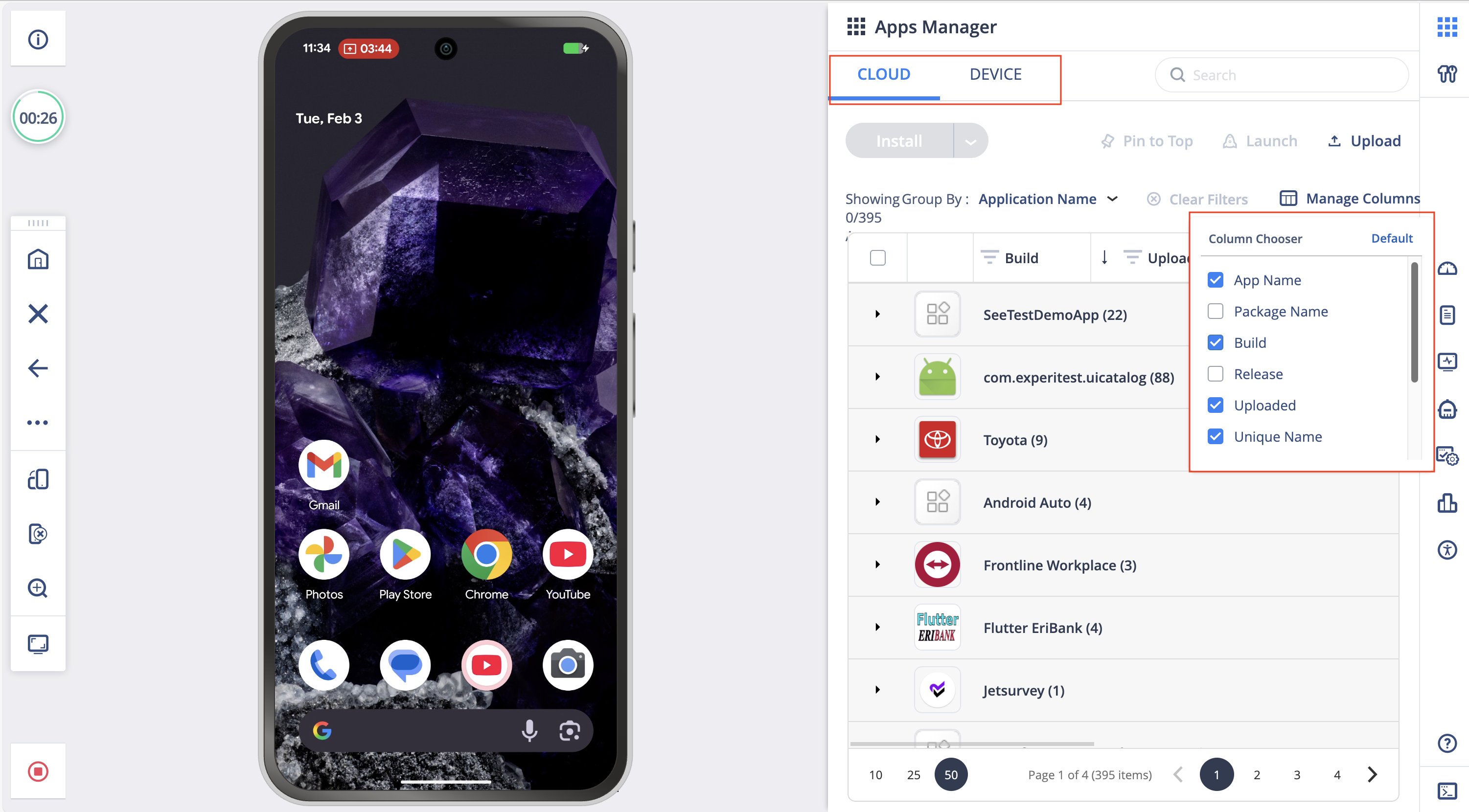
Cloud Tab
The Cloud tab serves as the central location for managing all applications stored in the cloud environment. It provides tools to organize, manage, and deploy applications efficiently. The Cloud tab displays all applications that have been uploaded by either you or other members of your project. Supported file formats include .ipa, .apk, and .aab.
If you’ve opened an iOS device, you will see iOS specific applications (.ipa).
If you’ve opened an Android device, you will see Android specific applications (.apk and .aab).
-
Displays all cloud-stored applications: Lists every application uploaded to the cloud, along with details such as name, package, and version.
-
Upload new applications: Enables adding applications directly from local storage to the cloud for future use.
-
Install on devices: Allows installing selected cloud applications onto connected devices, including instrumented versions for testing purposes.
-
Pin frequently used applications: Lets users pin preferred applications to the top of the list for quicker access.
-
Group and sort applications: Supports organizing applications by attributes like Application Name or Package Name, and sorting them as needed.
-
Perform application level actions: Provides options for managing, updating, or removing cloud applications as required.
Updated Default View and User Preferences
When a user opens the Application Manager for the first time, a default view is now applied to ensure a consistent and predictable experience.
Default grouping and sorting
By default, applications are grouped by Application Name. Groups are ordered by the most recently uploaded application first. Within each group, entries are sorted by build number.
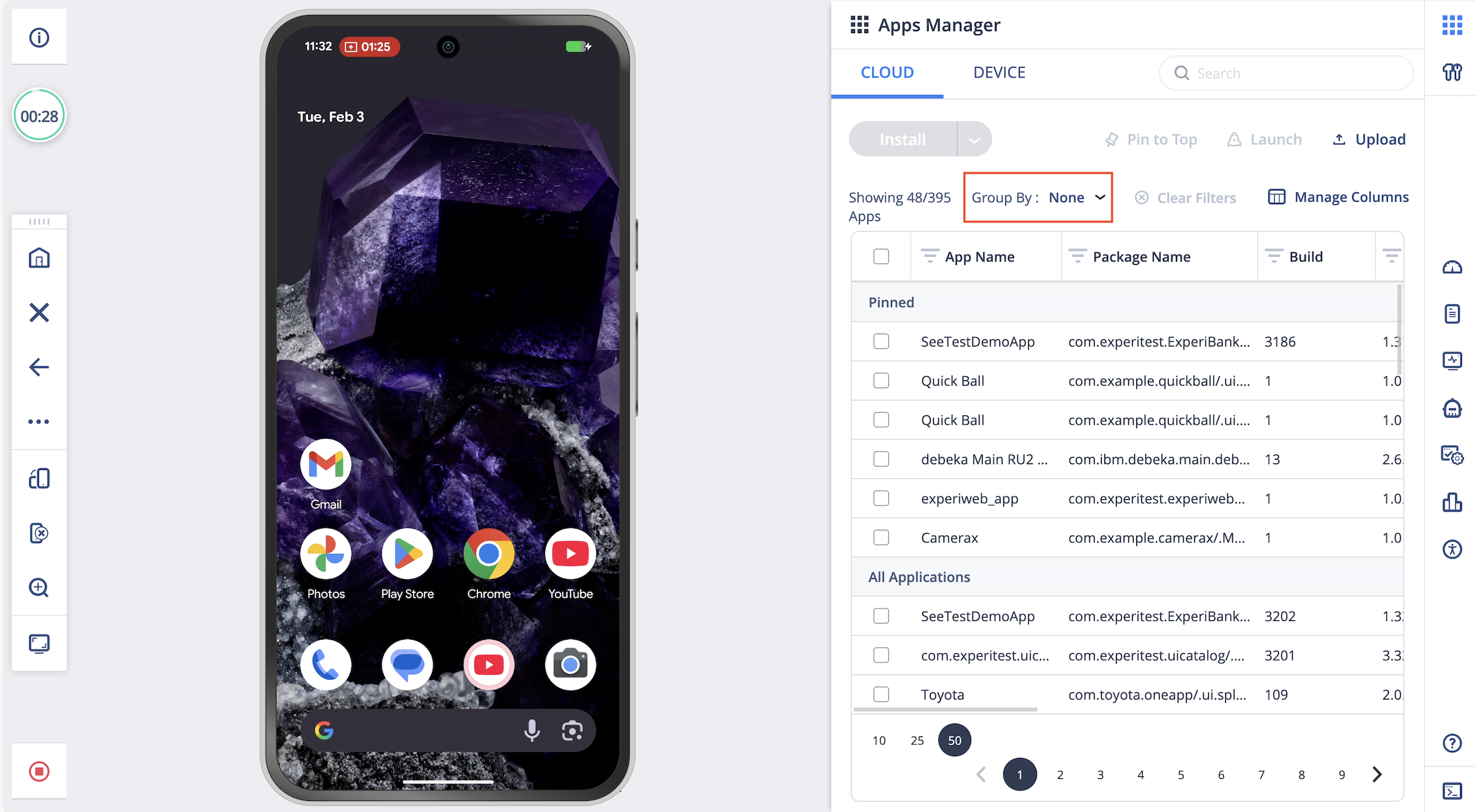
When grouping is set to None, all applications are displayed in a single list and sorted by most recent upload date and time, with the latest uploaded application appearing first.
Updated Launch Button Behavior
The Launch button is only enabled when the application is installed on the device and it is disabled otherwise.
The launch button will be active only when the application with same build number and release version is installed.
Default Column Visibility
The Application Manager now displays a simplified default column set. By default, only the following columns are displayed:
- Application Name
- Build
- Uploaded
- Unique Name
User-Specific Display Preferences
In Application Manager the display preferences are saved per user and not per device.
What this means
- Any changes a user makes (grouping, sorting, columns) are saved automatically
- The same preferences are applied every time the user opens any device
- Other users are not affected by these changes
Example
If a user changes the Grouping from Application Name to Package Name, that preference:
- Persists across sessions
- Applies to all devices opened by that user
Group By Behavior and Column Display Logic
The Application Manager adapts visible columns based on the selected Group By option.
| Group By selection | Column behavior |
|---|---|
| Application Name | Application Name shown in group header, not as a column |
| Package Name | Package Name shown in group header; Application Name appears as a column |
| None | No grouping; all default columns are shown |
The selected group-by field is always displayed in the group header instead of as a column.
Accordion Behavior for Grouped Views
When grouping is enabled:
- All application groups (accordions) are collapsed by default
- Only group headers are visible initially
- Users can expand individual groups to view details
When the grouping option is changed:
- All previously expanded groups are automatically collapsed
Application Icon Display Rules
Application icons are now displayed more intentionally to avoid repetition.
Group By enabled:
- Icon appears only once in the group header
- Icons are not displayed inside expanded rows
Group By = None:
- Icons are not displayed, since multiple builds of the same app may appear
Error Handling
When can an upload fail?
Application uploads can fail if the system cannot store or register the application in the project. The most common causes are listed below.
Common failure scenarios
-
Application already exists in the project (most common)
If an application with the same package, build, and version already exists in the project, the upload is rejected to prevent duplicates.
Behavior
- Cloud Prompts for a Unique name
- Mobile Studio - Upload fails with an
application already existsmessage
Resolution
- Cloud: Provide a unique name and re-upload
- Mobile Studio: Remove the existing app or upload from Cloud with a unique name
-
Network or connectivity issues
Upload may fail if the connection between the client and the Cloud is interrupted or unstable.
Examples
- Network latency
- Connection timeout
- VPN disconnect
- Firewall restrictions
Resolution
- Check network/VPN connection
- Retry the upload
- Verify required ports are open
-
Storage or service availability issues
Uploads depend on backend services such as file storage and application management services.
Examples
- File storage service unavailable
- Temporary server outage
Resolution
- Retry after a few minutes
- Check system status or contact the administrator
-
Unsupported or invalid file
The file may be rejected if it is corrupted or not supported.
Examples
- Wrong file type
- Incomplete download
- Corrupted archive
Resolution
- Rebuild or re-export the application
- Verify supported formats (
.apk, .ipa, .aab)
Device Tab
The Device tab provides a dedicated interface for managing applications installed on a connected device. It enables users to monitor, launch, and control applications directly from the device context.
-
Displays installed applications: Shows a complete list of applications installed on the selected connected device, including app details such as name, package, and version.
-
Application actions: Offers key actions to manage applications, including:
-
Launch: Starts the selected application on the device.
-
Launch Instrumented: Initiates the app with instrumentation for testing or monitoring purposes.
-
Uninstall: Removes the application from the device.
-
Uninstall (Keep Data): Uninstalls the application while retaining its associated user data on the device.
-
-
System app protection: Ensures that critical system applications cannot be uninstalled, preventing accidental device malfunction.
Key Visual Elements in Application Manager
| Visual Element | Description |
|---|---|
| Tabs (Cloud / Device) | Switch between managing cloud-hosted applications and device-installed applications. |
| Search Bar | Quickly locate applications by name or package. |
| Action Buttons (Top-right) | |
| Upload | Upload new applications from local storage to the cloud. |
| Install / Install Instrumented (Cloud tab) | Install selected applications onto devices/ Install the application with instrumentation for testing or monitoring purposes. |
| Launch / Launch Instrumented (Cloud tab) | Launch applications installed on the device. Note: There can be multiple builds or release versions of the same application available in the cloud. The Launch button is enabled only for builds that are installed on the selected device. |
| Uninstall / Uninstall (Keep Data) (Device tab) | Remove applications from the device/ Remove application from the device but retain the data. |
| Pin to Top (Cloud tab) | Keep frequently used applications at the top of the list for quick access. |
| Group By | Organize applications by Application Name or Package Name. |
| Manage Columns | Customize which columns (App Name, Package Name, Version) are visible. |
| Filters | Apply or clear filters to narrow results. |
| Sorting | Sort applications by name, package, or version (ascending/descending). |
| Pagination | Navigate through multiple pages of applications. The preference retained across sessions. |