Implement SAFe in Agility

Digital.ai Agility provides a centralized environment for adopting agile at each Scaled Agile Framework (SAFe)® level: Portfolio, Development Value Stream, Program, and Team.
Who implements SAFe
Different roles lead SAFe implementation at different levels:
- Portfolio Managers and Executives: Drive SAFe adoption at Portfolio level, define strategic themes, and manage portfolio backlog
- Program Managers (RTE): Coordinate Agile Release Trains, facilitate PI Planning, and manage program-level features
- Scrum Masters: Implement SAFe practices at Team level, facilitate agile ceremonies, and coach teams
- Administrators: Configure SAFe terminology, set up planning levels, and enable SAFe features
Edition requirement: Many SAFe features (Portfolio Kanban, Program Board, Strategic Themes) require Enterprise or Ultimate editions. Check your edition (System > About) to verify feature availability.
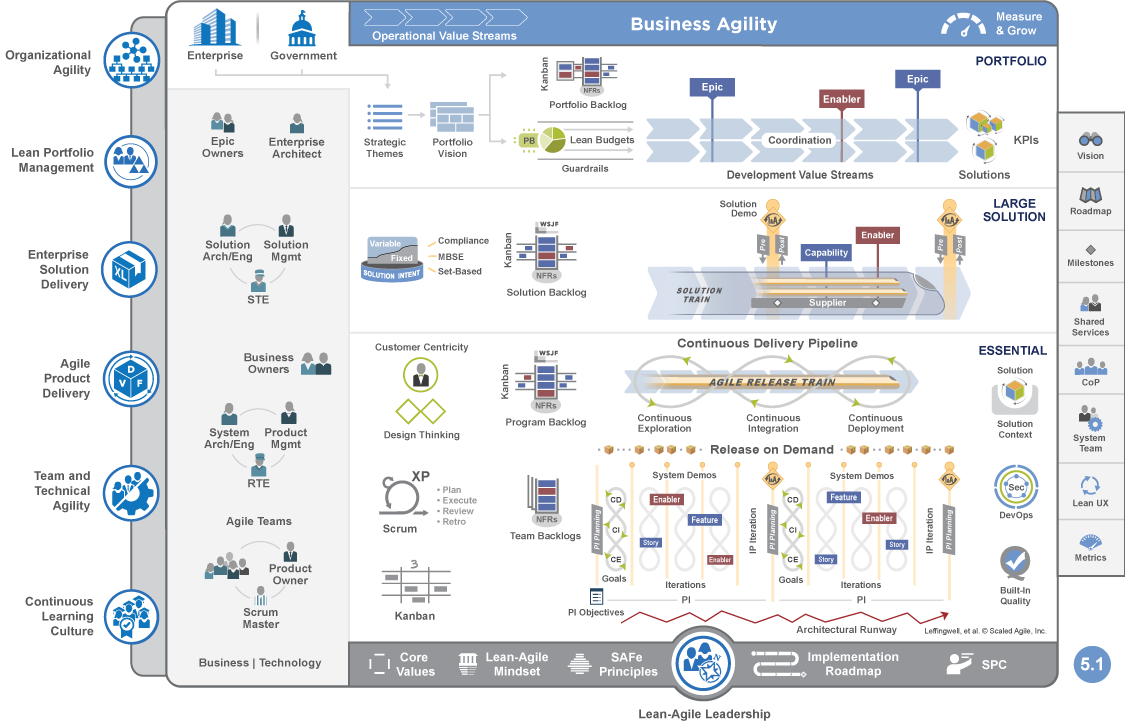
Portfolio Level
The strategies that drive enterprise initiatives, development value stream funding, and epic-level decision making occurs at the Portfolio level. You can use these Digital.ai Agility features to assist you in capturing your portfolio backlog and simplifying your portfolio planning and management processes.
- Strategic Themes
- Budgets
- Portfolio Items
- Portfolio Kanban
- SAFe Terminology Configuration
- Key Metrics Available at the Portfolio Level
Development Value Stream
The Development Value Stream level is optional and is intended for large, complex systems consisting of multiple agile release trains. These features fully support SAFe’s Development Value Stream level, allowing planning, tracking, and delivery of the largest, most complex systems.
In Digital.aiAgility...
- Capabilities Kanban
- PlanningRoom
- Roadmapping
- Key Metrics Available at the Development Value Stream Level
In Continuum™ for DevOps...
A suite of Continuum™ tools that optimize and centrally manage your entire software development, application management, and enterprise automation processes.
Program level
Coordinate your release train to integrate software assets across all teams:
- Feature Board
- Program Backlog
- Roadmap Timeline
- Program Board
- PlanningRoom
- Project Workspaces
- Key Metrics Available at the Program Backlog Level
Team level
Support agile and lean software development workflows:
- TeamRooms
- PlanningRoom
- Collaboration Tools
- Key Metrics Available at the Team level
Collaboration tools
Integrated tools for fresh, relevant information during development:
- Communities of Practice
- Conversations
Additional resources
Visit https://digital.ai/resources/agility for:
- Flexible Scalability using On-Premise or Hosted Agile Platforms
- Implement SAFe 5.0 with Agility and Jira
- How to Get Visibility of the Entire Flow of Value across Agile & DevOps
- Scaled Agile Framework (SAFe) Quickstart Guide
SAFe® and Scaled Agile Framework® are registered trademarks of Scaled Agile, Inc.
Common Use Cases
Enterprise SAFe phased rollout
A large enterprise with 500 developers across 15 locations decides to adopt SAFe 5.0 over 18 months. They begin at the Team level by creating TeamRooms and PlanningRooms for 20 existing Scrum teams, training teams on sprint execution and retrospectives. After two successful quarters, they implement the Program level by creating three Agile Release Trains, using the Program Board to visualize cross-team dependencies during PI Planning events, and tracking 45 features on the Feature Board. In month 12, they add Portfolio level capabilities including Strategic Themes aligned to business objectives, Portfolio Kanban for epic management, and budget tracking across value streams. By month 18, all SAFe levels are operational with measurable improvements in predictability and time-to-market.
Small-scale SAFe adoption
A 50-person software company adopts SAFe at the Program level only, skipping Portfolio and Value Stream levels to match their organizational size. They configure four teams under one Agile Release Train, use the Program Board to coordinate work across teams during 10-week Program Increments, track 20-30 features on the Feature Board each PI, and run PI Planning events every 10 weeks using PlanningRoom for distributed team participation. After one year, velocity predictability improves by 40% and cross-team dependencies decrease by 60%, validating their scaled approach without enterprise-level portfolio overhead.
Hybrid Scrum-to-SAFe transition
A mid-sized company transitions from standalone Scrum to SAFe incrementally. They start with familiar Team level features (TeamRooms for eight teams, sprint planning, daily standups, retrospectives) while maintaining existing Scrum practices. After three months of stable team execution, they introduce Program level coordination with quarterly PI Planning using the Program Board to visualize 12-week increments, the Feature Board to track cross-team features, and Roadmap Timeline for stakeholder communication. After six months of successful program execution, they add Portfolio level governance including Strategic Themes for business alignment and Portfolio Kanban to manage large epics, completing a gradual 12-month transition that minimizes disruption while scaling effectively.
Frequently Asked Questions
Do I need to implement all SAFe levels at once?
No, you can implement SAFe incrementally based on your organizational size and maturity. Many organizations start with Team level features to stabilize team execution, add Program level coordination after teams are performing well, and introduce Portfolio level governance only when managing multiple programs or value streams. Phased adoption reduces change management challenges and allows teams to adapt gradually.
Can I use Digital.ai Agility for SAFe without implementing all levels?
Yes, Agility supports flexible SAFe implementation. Small organizations may only need Program and Team levels. Mid-sized companies often implement all levels except Value Stream. Large enterprises may use all four levels. Choose the levels that match your organizational structure and scaling needs. You can always add additional levels later as your organization grows.
What is the difference between Portfolio Items and Features?
Portfolio Items (Epics) are large strategic initiatives that typically span multiple Program Increments and deliver significant business value. Features are smaller pieces of functionality that teams can deliver within one Program Increment (typically 8-12 weeks). In the SAFe hierarchy, Portfolio Items decompose into Features, and Features decompose into Stories. Use Portfolio Items for strategic planning and Features for program-level planning.
How does PlanningRoom support PI Planning?
PlanningRoom provides a collaborative digital workspace for distributed PI Planning events. Teams can view the Program Board showing all features across the PI timeline, identify dependencies with red lines connecting features, commit to PI objectives, and participate in planning discussions remotely. PlanningRoom enables multi-location PI Planning, maintains planning artifacts for reference, and supports asynchronous planning for globally distributed teams.
Can I configure SAFe terminology to match my organization?
Yes, Digital.ai Agility includes SAFe Terminology Configuration that allows you to customize labels and terms to match your organization's language. For example, you can rename "Program Increment" to "Release Train" or "Feature" to "Capability" if your organization uses different terminology. This flexibility helps with adoption by aligning the tool with your existing vocabulary.
What metrics are available at each SAFe level?
Portfolio level: Epic cycle time, portfolio flow, investment distribution by theme. Program level: Feature cycle time, PI predictability, program velocity, dependency resolution time. Team level: Sprint velocity, burndown, cumulative flow, defect trends, test pass rates. Each level provides metrics appropriate for decision-making at that scope, supporting data-driven leadership and continuous improvement.
How do Strategic Themes align to Portfolio Items?
Strategic Themes represent business objectives or strategic differentiators (e.g., "Improve Customer Experience", "Cloud Migration", "Security Enhancement"). You assign Portfolio Items (Epics) to Strategic Themes to show how epics support business strategy. This alignment enables portfolio managers to track investment distribution across themes, ensure balanced funding, and demonstrate how technical work connects to business goals during executive reviews.
What if we use different terminology than SAFe?
Digital.ai Agility supports terminology customization through SAFe Terminology Configuration and List Type Administration. You can rename asset types, planning levels, workflow states, and other terms to match your organization's language. This is particularly valuable for organizations adopting SAFe principles while maintaining their own scaling framework terminology or for companies in regulated industries with specific vocabulary requirements.
Can we implement SAFe across multiple sites and time zones?
Yes, Digital.ai Agility is cloud-based and supports distributed SAFe implementation. Use PlanningRoom for distributed PI Planning across time zones, Program Board for asynchronous dependency identification, Conversations for cross-site collaboration, and Communities of Practice for knowledge sharing across locations. Many global enterprises successfully run SAFe with teams spanning Americas, EMEA, and APAC regions using Agility's collaborative features.
How does Digital.ai Agility handle Program Increments (PIs)?
Program Increments are represented using Planning Levels in the project hierarchy and date-based columns on the Program Board. Configure PI duration (typically 8-12 weeks) in your schedule settings, use the Program Board to visualize feature delivery across PI sprints, track PI Objectives in project descriptions or custom fields, and measure PI Predictability by comparing planned vs. delivered features. The system supports overlapping PIs for different ARTs and rolling wave planning for future PIs.
What is the relationship between Programs and Projects in Agility?
Programs group related projects (teams) that work together on the same product or solution, typically representing an Agile Release Train in SAFe. Projects represent individual teams or planning levels within the program. For example, a "Mobile Banking" program might contain five team projects: iOS Team, Android Team, Backend Services Team, QA Team, and DevOps Team. Use Programs to filter and aggregate data across all teams in an ART.
Can we track Agile Release Trains (ARTs) in Digital.ai Agility?
Yes, ARTs are typically represented as Programs in Agility. Create a Program for each ART, assign team projects as children of the Program, use the Program Board to coordinate ART-level planning, track ART-level features on the Feature Board, and report on ART velocity and predictability using Program-level metrics. This structure supports multiple ARTs within a portfolio and enables ART-to-ART dependency management.
Related Topics
- Get started by role - Find guidance for your role
- Programs - Group and filter projects across hierarchies
- Strategic themes - Support portfolio-level planning